MiRoya
Understanding the biophysical mechanisms underlying
coffee rust epidemics and testing different control
methods
The MiRoya model was developed as part of the PROCAGICA
project, the Central American Programme for the
Integrated Management of Coffee Rust. PROCAGICA was funded
by the European Union. One of the components of Procagica
is the establishment and strengthening of a Regional Early
Warning Network (RRAT) for coffee risk management at the
Central American level (a network of SAT-coffee
institutions in Central America).
The countries involved in this network are: Nicaragua, El
Salvador, Honduras, Guatemala, the Dominican Republic,
Panama and Costa Rica.
Authors :
Jacques Avelino, CIRAD - CATIE
Edwin Treminio, CATIE
Pierre Bommel, CIRAD - CATIE
Grégoire Leclerc, CIRAD - CATIE
Natacha Motisi, CIRAD - CATIE
Isabelle Merle, CIRAD - CATIE
Rémi Vezy, CIRAD
|
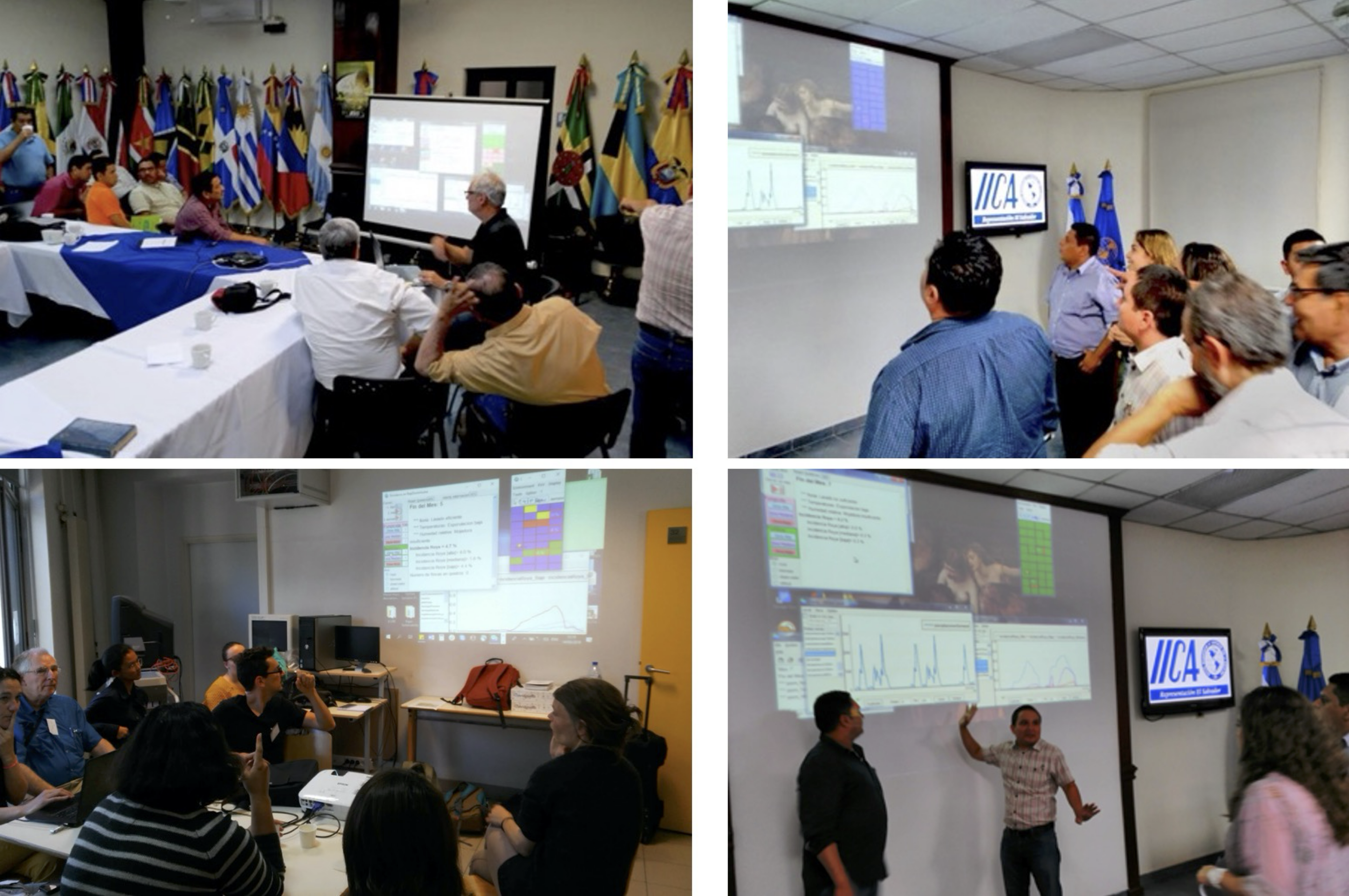 Some
photos of workshops using the MiRoya interactive
simulator Some
photos of workshops using the MiRoya interactive
simulator
|
MiRoya's objective
The primary objective of the MiRoya model is to integrate
and validate scientific data and expert knowledge into a
simulation model, in order to:
- Understand the biophysical
mechanisms of coffee orange rust
- Prioritize the parameters
influencing rust outbreaks
- Share knowledge,
- Test hypotheses,
- Test different methods of
controlling rust and
- Consolidate a Regional Early
Warning Network for Coffee Rust (RRAT)
MiRoya’s aim is to provide an interactive simulator to
stimulate discussion on the socio-economic aspects of
coffee production in the context of a coffee leaf rust
crisis. This game is designed to facilitate the
coordination of alerts and measures at an institutional
level.
Description of MiRoya
A description of the MiRoya model is available in
Spanish.
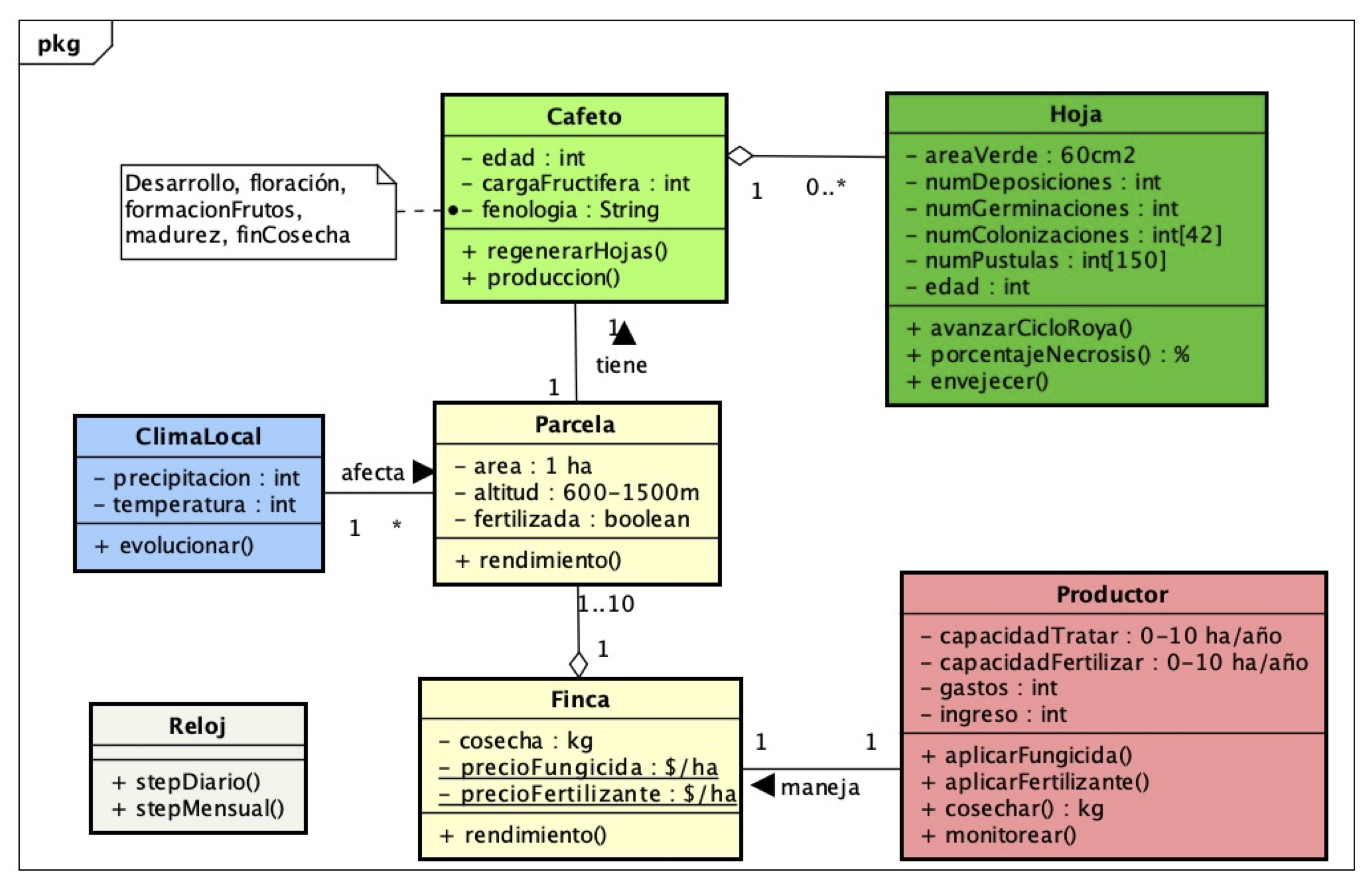
The following UML class diagram illustrates the structure
of the model. Note that the fungus (rust) is not
represented as an entity, but only in the form of
quantities in different states carried by each leaf:
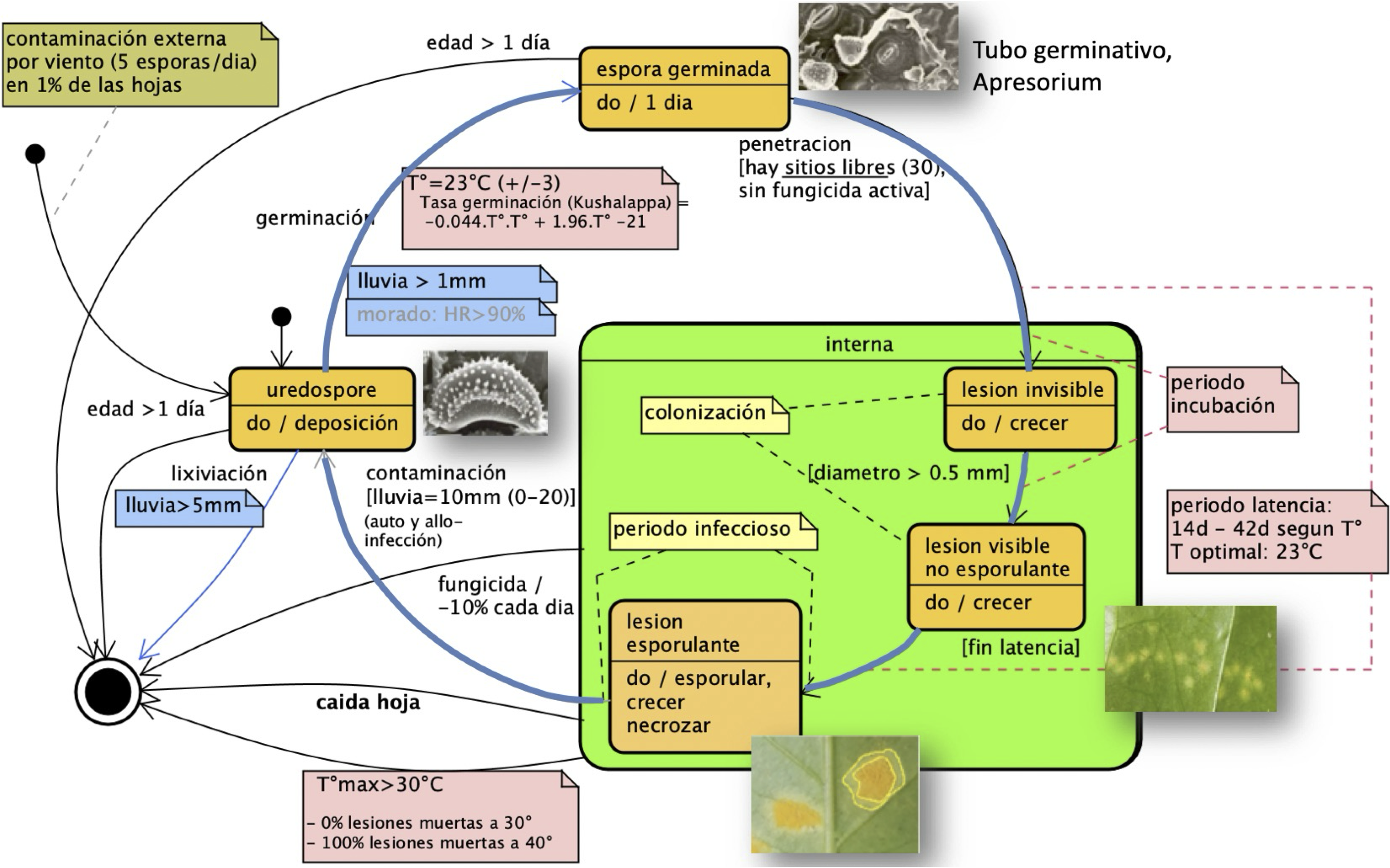
The diagram below illustrates the life cycle of rust, in the form of an enhanced UML state-transition diagram:
The diagram below illustrates the life cycle of rust, in
the form of an enhanced UML state-transition diagram:
This life cycle must be coupled with that of the coffee
plant, which gives rise to complex dynamics:
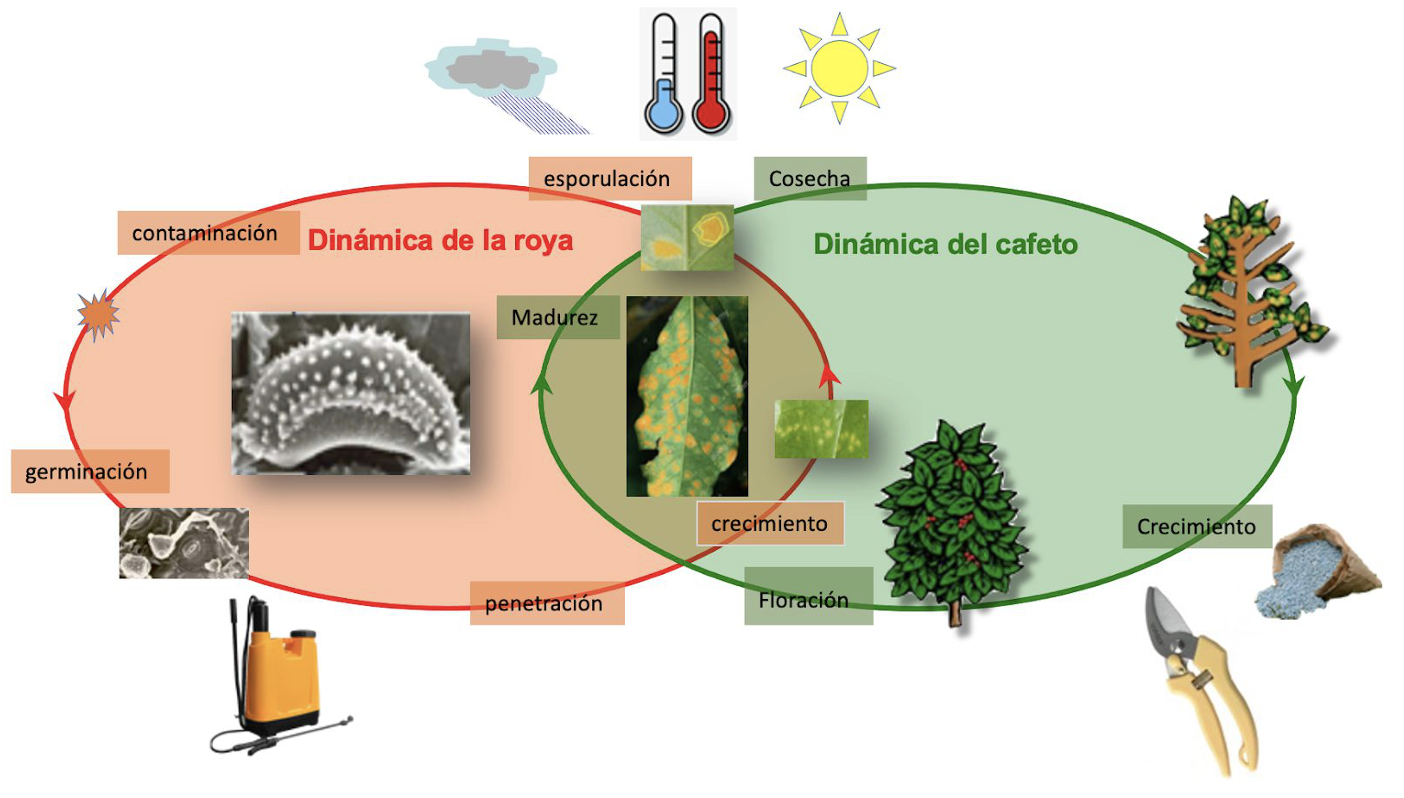
Diagram of two coupled processes: the growth
dynamics of the coffee plant and the spread dynamics of
orange rust.
See the full description on the website of Pergamino.
Installation
The current version of the model consists of two
independent modules: a rust dynamics sub-model (MiRoya)
and a coffee tree growth sub-model (DynaCof).
DynaCof
is a model implemented in the R language by Rémi Vezy. To
use DynaCof, R must therefore be installed on your
computer.
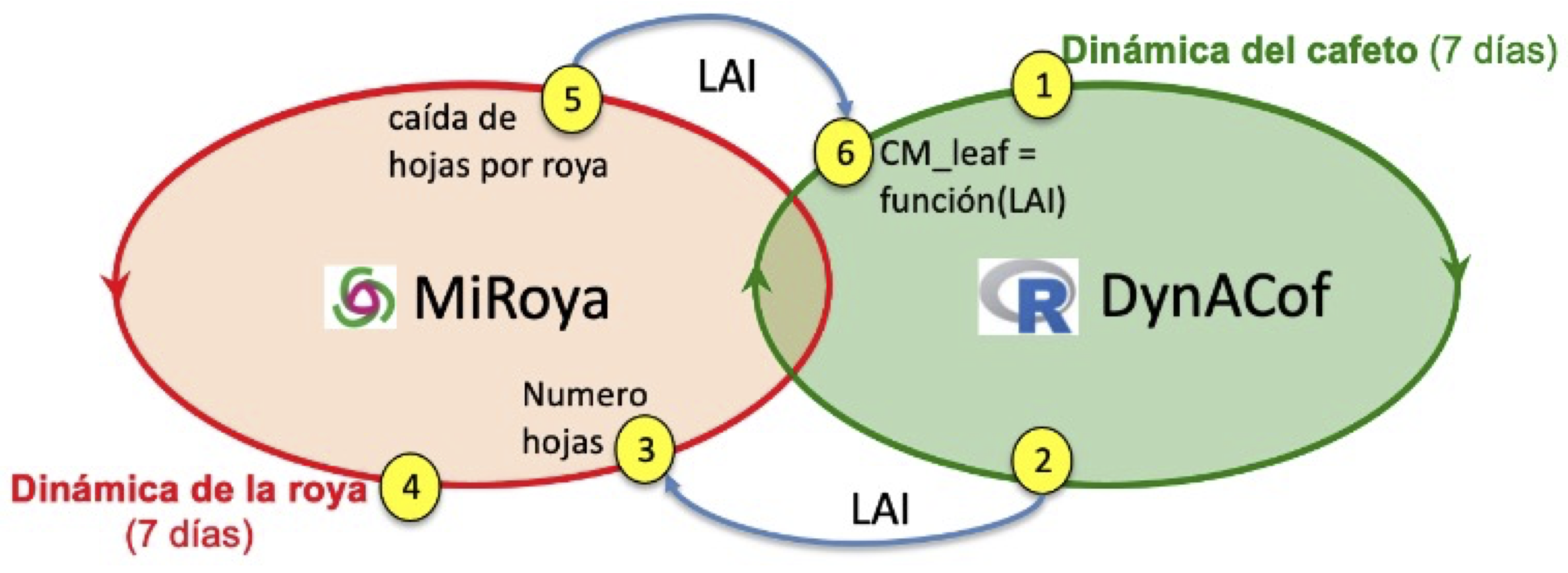
Dynacof manages leaf growth, whilst MiRoya manages the
rust life cycle and its effects on leaf fall.
The time step for Dynacof and MiRoya is one day. However,
as data exchange between the two models is slow,
interactions take place on a weekly basis. As shown in
Figure 11, a complete one-week cycle comprises six steps:
- R runs DynACof for seven days, which calculates
(among other things) leaf growth,
- R calls Cormas with a new LAI value (leaf area
index)
- MiRoya adjusts the number of leaves according to the
LAI
- Cormas runs 7 days of MiRoya: fungal life cycle,
- MiRoya determines leaf loss due to rust
- Cormas returns an LAI value to DynACof. The carbon
mass (CM_leaf = leaf carbon mass, in g/m²/day) is
modified by calculating the difference in LAI between
time t and time - 7:
CM_leaf(t) ← CM_leaf(t) . [LAI(t) - LAI(t-7) / LAI(t-7)]
MiRoya How to install MiRoya (in
Spanish).
MiRoya User Guide
The guide
is also available in Spanish
You can download the model
on GitHub
|
|

