|
SIS: Epidemiology system of Susceptible - Infectious
B. Bonté, P.
Bommel
A simple SIS (Susceptible - Infected System) model, which
allows the users to compare 3 types of paradigms on the
same simple model in epidemiology: continuous differential
equations, discrete model and several implementations in
an ABM.
Objective
This is the replication of a standard epidemiological
model which simulates the spread of an epidemic in a
society: healthy people (also called Susceptibles) can become sick (Infected) when they come
into contact with other people already carrying the
disease. In turn, they contribute to spreading the disease
when they meet other people.
In this model, the disease is not dangerous. After a
while, infected people become susceptible again.
A simulation must therefore monitor the number of infected
and healthy people over time.
This model presents two main versions:
Version 1: global level (differential equations)
In the first variation, the "global" version, the
individuals are not represented, but only the populations
of Susceptibles and
Infected :
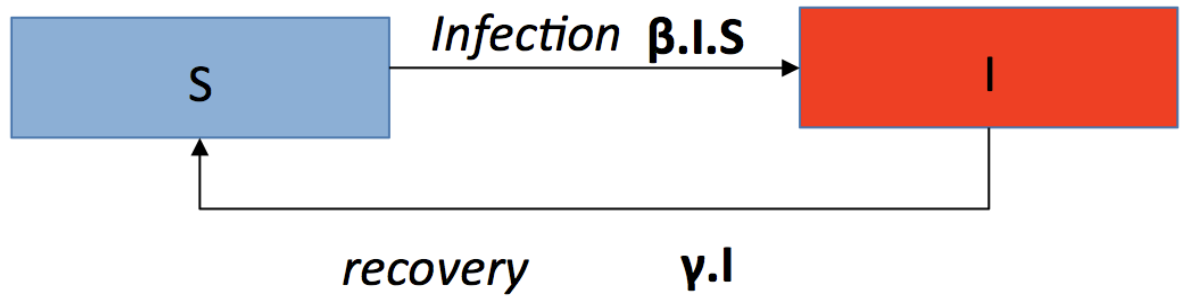
S: number of susceptibles individuals.
I: number of infected individuals.
β: Infection rate (0.3).
γ: recovery rate (0.1)
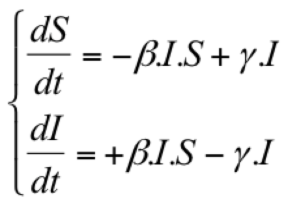
This can be translated as a system of 2 differential
equations (continuous model):
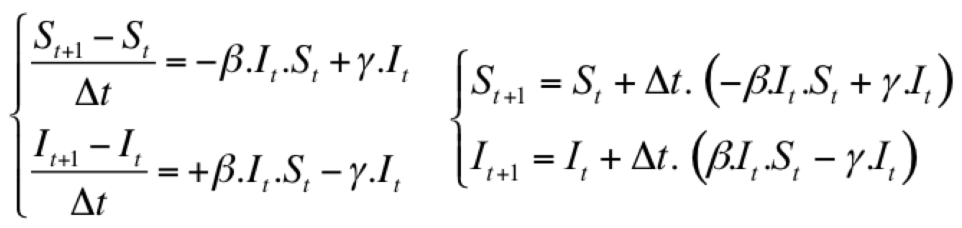
This continuous model can be discretized by transforming dt
to deltaT :
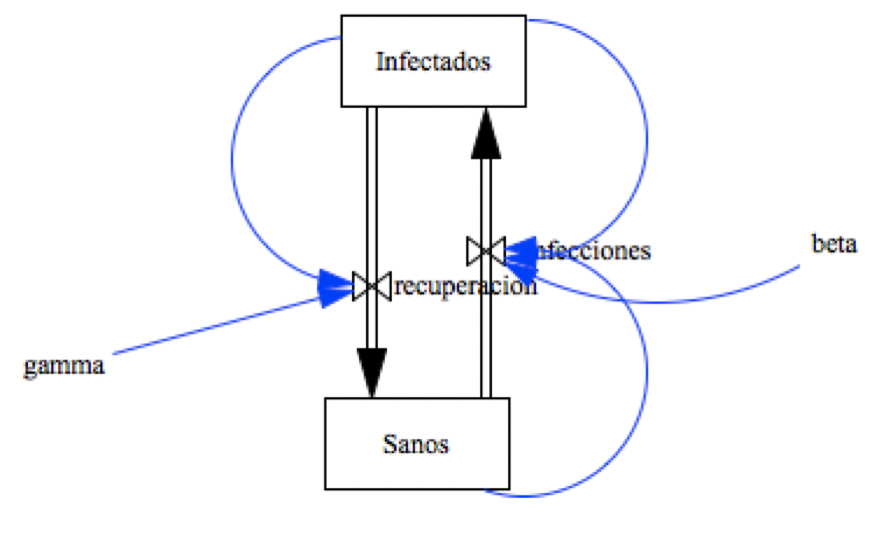
Here is a view of the stock & flow model with Vensim:
The following picture is a simulation with Vensim
from 3 different initial states :
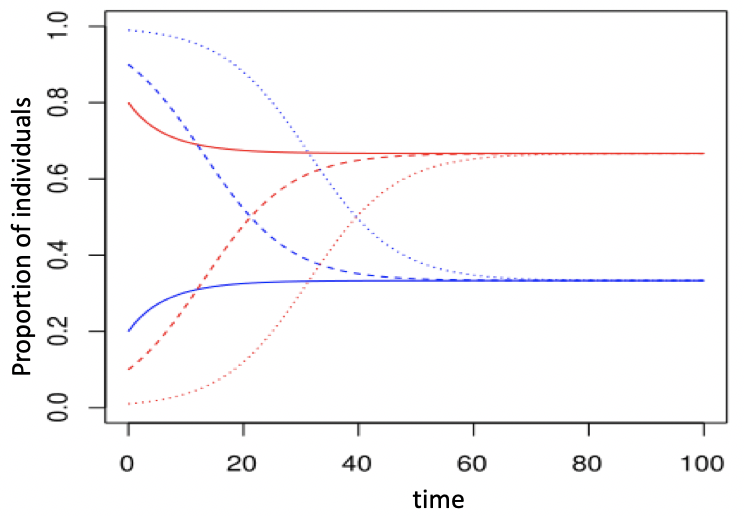
Note that, at equilibrium:
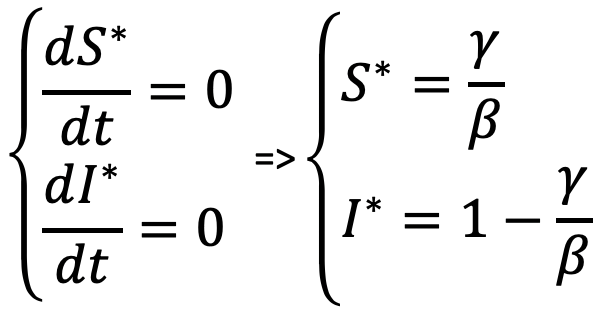 After a while, S and
I are stable and there level depends solely on β and γ: S*=1/3 and I*=2/3 After a while, S and
I are stable and there level depends solely on β and γ: S*=1/3 and I*=2/3
Version 2: ABM
The second variation, the "ABM" version explicitly
represents the individuals of the system.
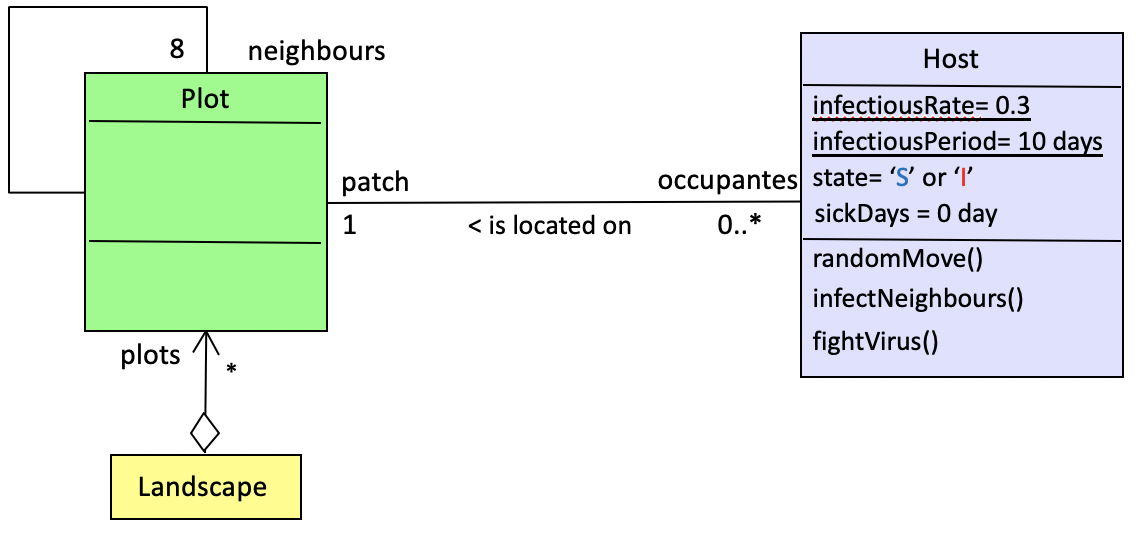
The previous infectious rate (β = 0,3) is
now an infection probability for each agent to
become infected when in contact with another infected
agent (30%). The recovery rate must also be adapted at the
individual level. For example, it can be transformed in an
Infectious Period of 10 days. After this period, the sick
agent recovers. In other words, γ (10%,
defined at population level) is translated as a recovery
period of 10 days, defined at individual level.
When moving on the landscape, the agents may meet
randomly. In order to have a meeting probability
equivalents to the one of the global model, the size of
the space must be calculated according to the size of the
population.
The parameter ß (Infection rate: 0.3) can be expressed as
:
ß = -k log(1 - c) ,
where
* k is the average number of
contacts between two individuals per unit of time, and
* c is the probability that a
contact between a susceptible individual and an infectious
individual will result in an infection. So c
equals
infectiousProbability (=0.3).
By setting c to 0.3, we calculate k = -ß / log(1 -
c) = -0.3 / log (0.7) = -0.3 / (0.7 log) = 1.93671
There are k = 1.93671 contacts between two individuals per
step.
Thus, for a neighborhood of 8 (Moore), 1 agent has a 1/8
chance of going to the cell of a neighboring agent.
If X.Y is the size of the grid, then
popSize = k * X.Y/ 8 <=>
X.Y = popSize * 8 /k
In Cormas, this implementation shows the following spatial
grid:
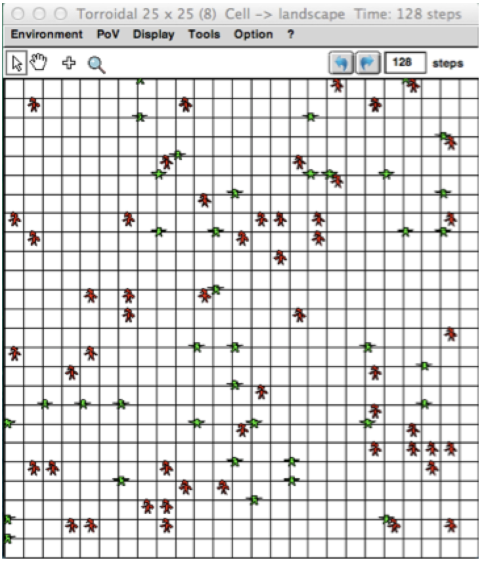
But this transformation from the global model
(differential eq.) to the ABM corresponds to one way of
doing (the No Spatial, Infectious Period scenario). It
can be set differently, as presented now:
Implementations and comparison of the following
scenarios
By using SIS in Cormas, you can select one among 7
scenarios:
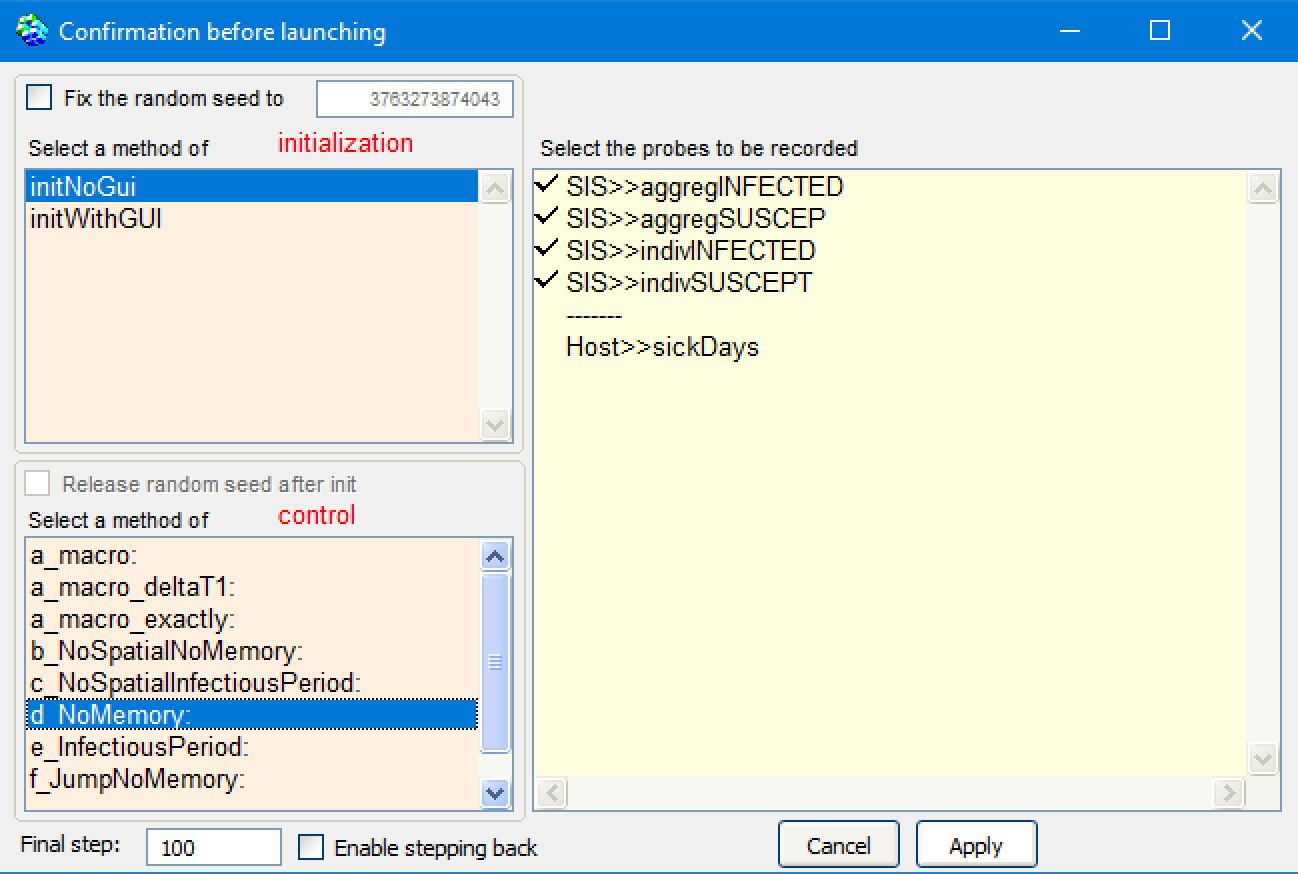
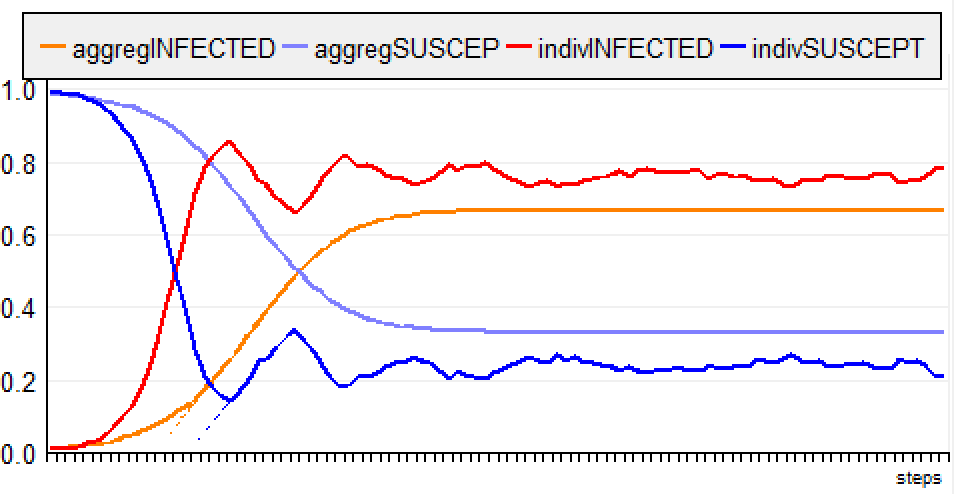
For each scenario, the results of the discrete equation
model (global model) and the agent model (local model) can
be compared (aggregINFECTED vs indivINFECTED).
It is initialized with at least 1000 hosts.
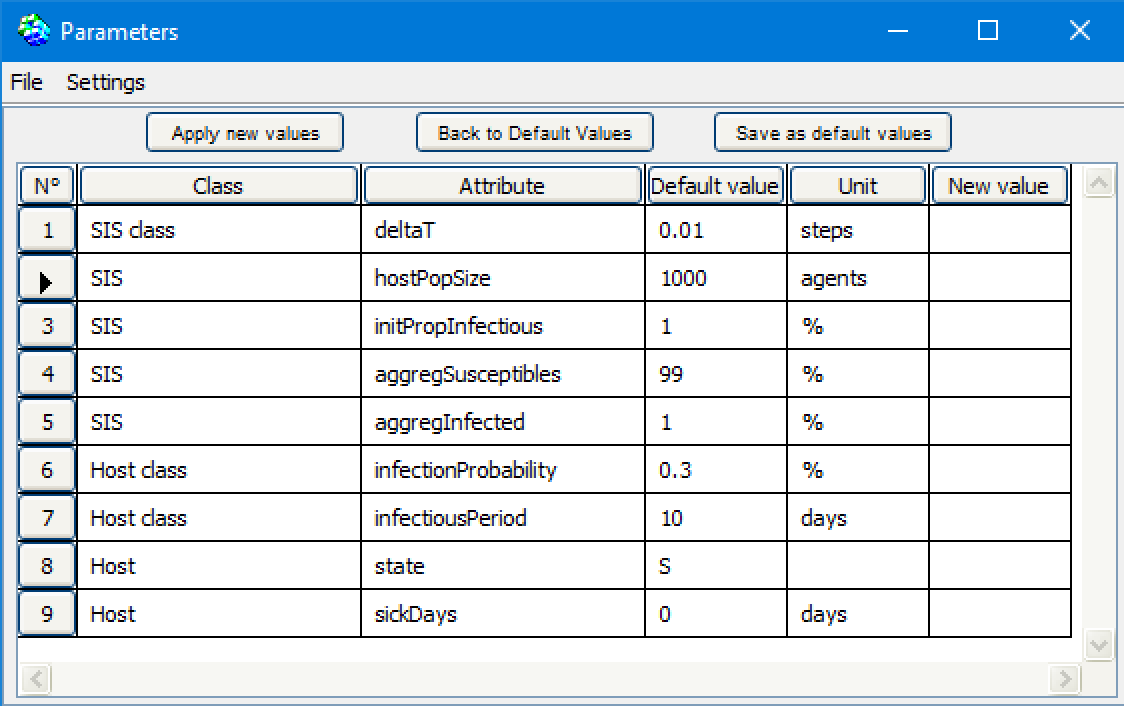
All the parameters are presented in this table:
a) macro
Here, the agents do nothing: their state are changed by an
outside operator: the result of the global model.
In this version (a_macro_deltaT1), the model calculates
the number of infected and susceptible agents according to
the discrete equation with delta T = 1. It is compared
with the discrete global model with deltaT set to 0.01:
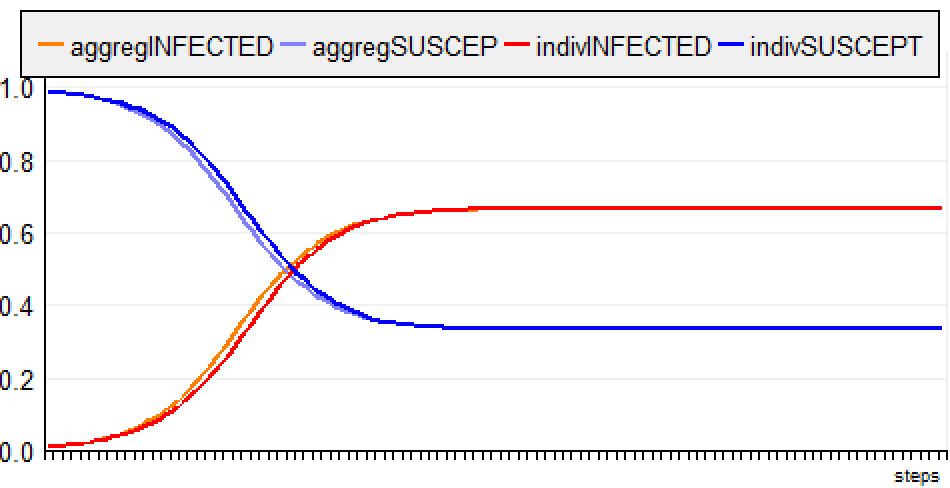
Here the curves for both scenario (aggregated and
individual) are quite similar, which makes sense. The
small difference is due to the resolution time: deltaT = 1
in the case of the ABM and deltaT = 0.01 for the global
model.
b) No Spatial, No Memory
The agents are not situated. They meet randomly, ie. each
infected host can infect one of the agent randomly pick in
the population. If this agent is susceptible, he can
become infected with a probability (infectionProbability =
0.3).
When infected, an agent has a probability of 10% to
recover each day..
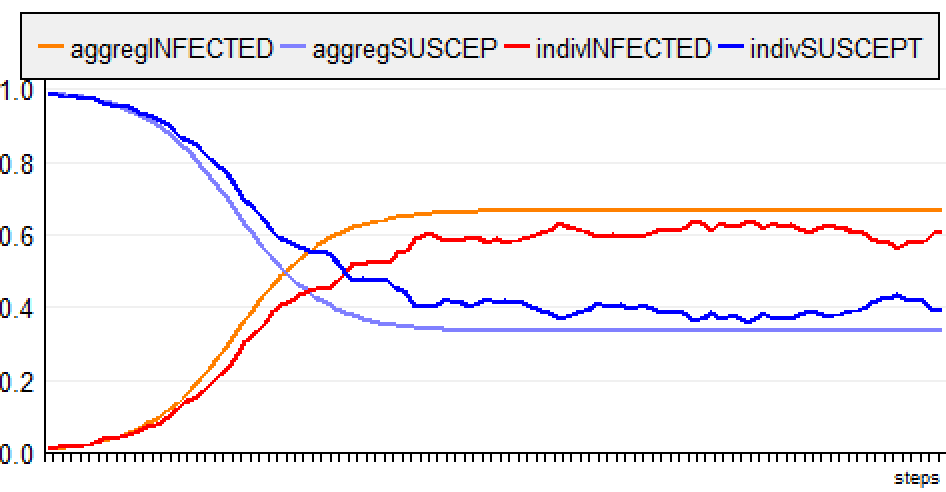
For the ABM, the evolution of the disease is a little
slower and the rate of infection stabilizes around 0.6
(instead of 0.666).
c) No Spatial, Infectious Period
The agents are not situated. They meet randomly, ie. each
infected agent can infect one of the agent of the
population.
When infected, an agent is infectious during 10 days.
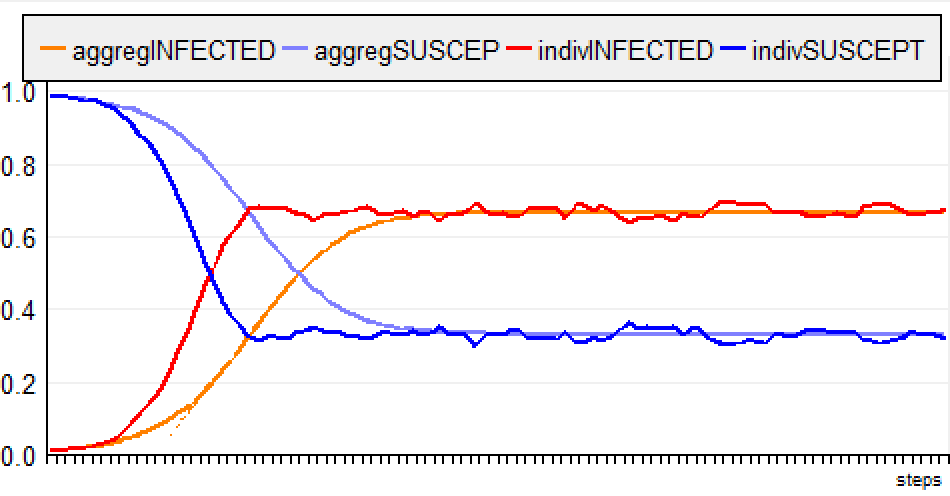
For the ABM, the evolution of the disease is faster but
the rate of infection stabilizes around 0.666 (like for
the global model).
d) NoMemory
The agents are situated on the grid (for 1000 agents, the
space dimension is set to 65x64 cells = 4160 cells). They
can meet each other when moving randomly.
When infected, an agent has a probability of 10% to
recover each day.
The step (and the following) is divided in 3 phases:
1) all the agents move,
2) the infected hosts may infect their
neighbours (located on the same cell, with
infectionProbability),
3) the infected hosts fight the virus (10%
probability to recover)
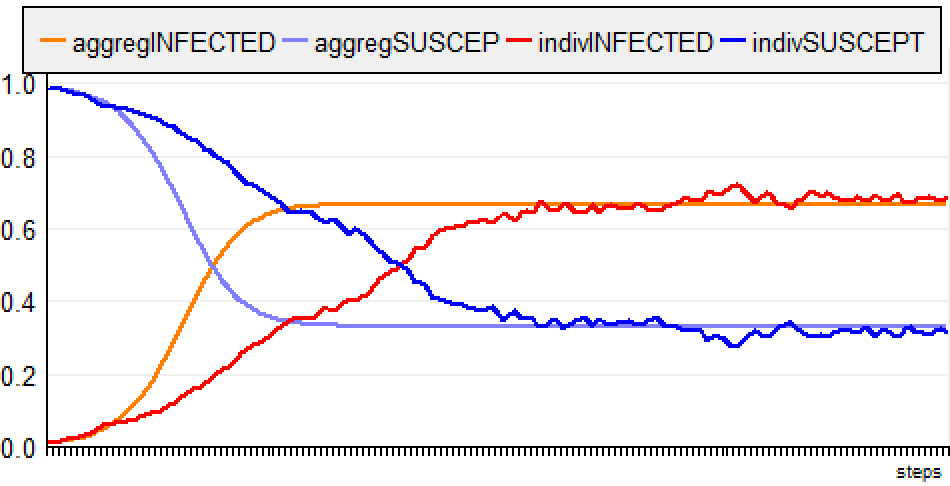
(the simulation is run for 150 steps, in order to verify
that the curves are finally aligned with the equilibrium
state). For the ABM, the evolution of the disease is a
much slower and the rate of infection stabilizes around
0.6 (instead of 0.666).
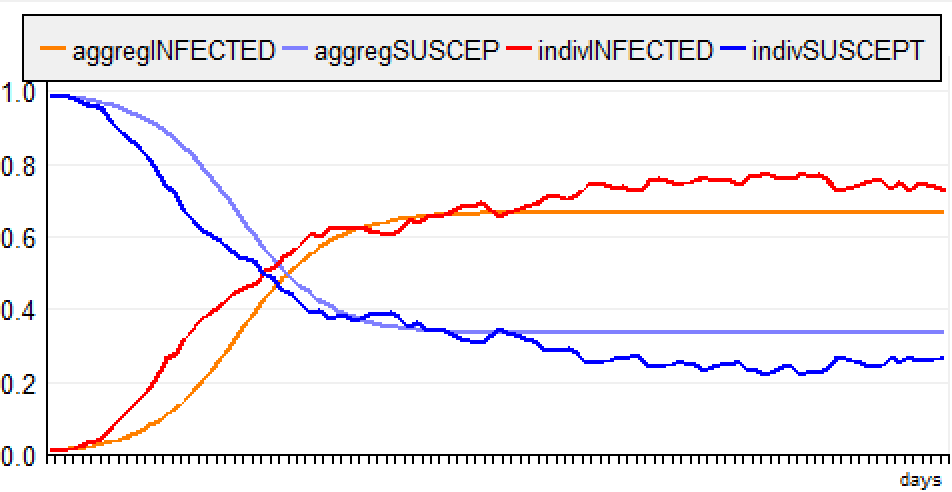
e) Infectious Period
The agents are situated and move randomly. When infected,
an agent is infectious during 10 days.
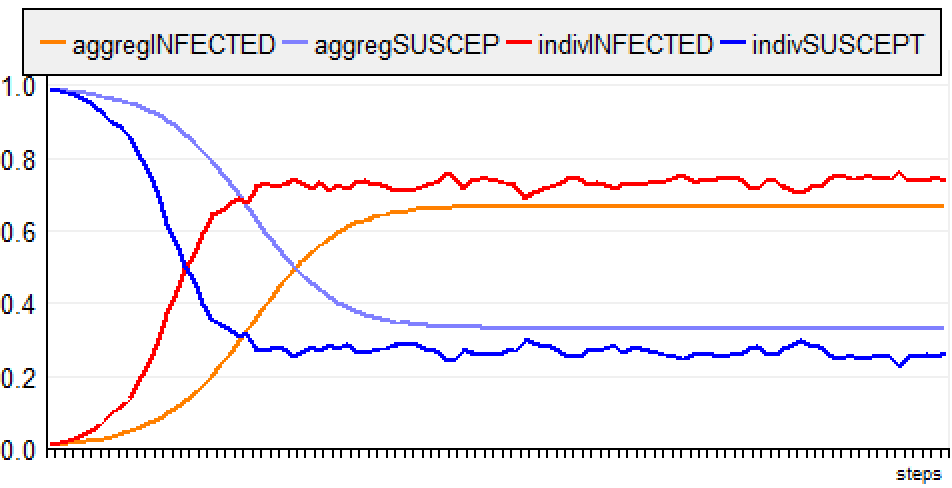
f) Jump NoMemory
The agents are situated and jump to a random plot. When
infected, an agent has a probability of 10% to recover
each day.
g) Jump, Infectious Period
The agents are situated and jump randomly. When infected,
an agent is infectious during 10 days.
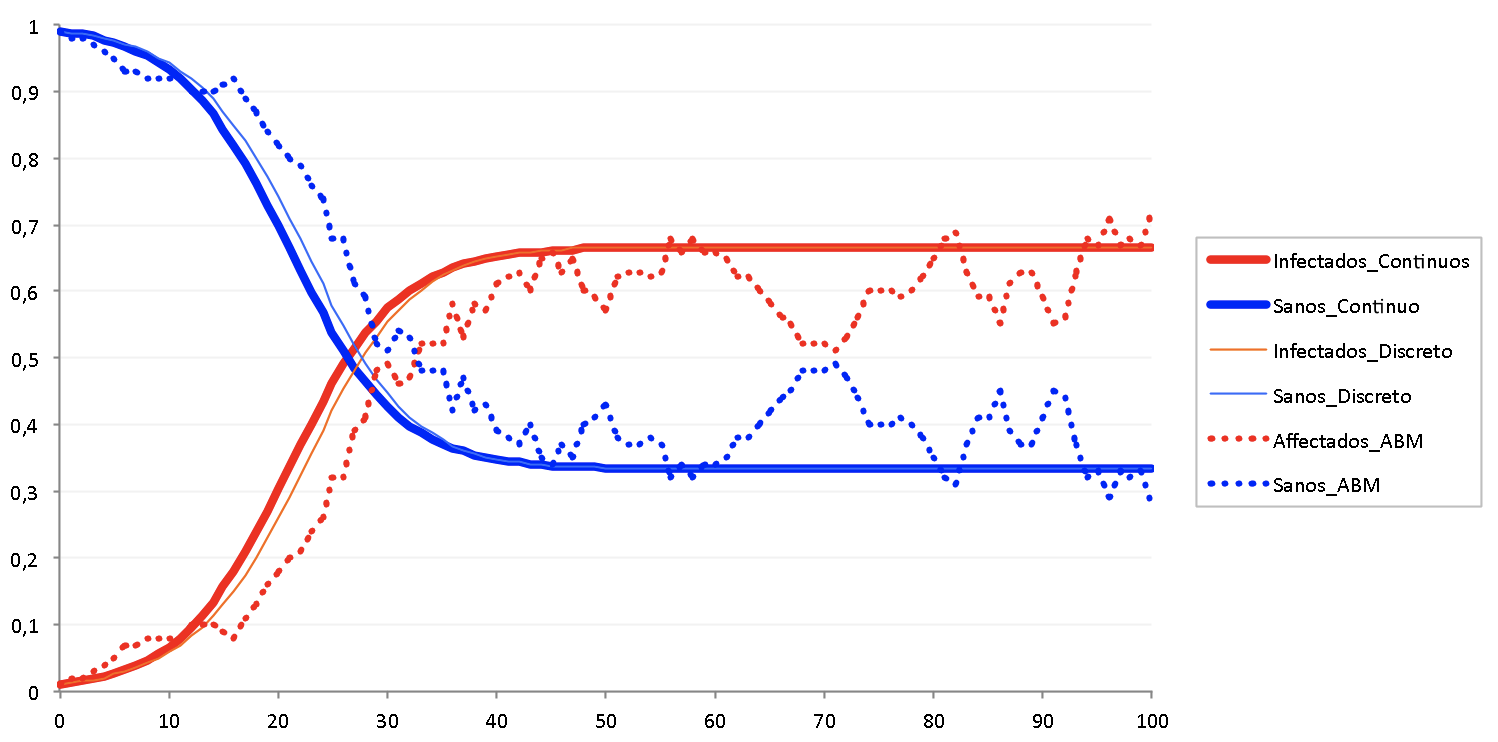
Finally, the following chart enables to compare a similar
model designed according to 3 types of paradigms: the
continuous differential equation (thick lines), the
discrete differential equation (thin lines) and the ABM-e
(dotted lines):
Conclusion
Even for a very simple model, there are several ways to
formalize it, which often leads to similar but not
identical simulations. For the two "global" models
(continuous and discrete differential equations), we
already notice small differences when delta T = 1 (cf.
previous figure).
The translation of this model into ABM requires
adjustments (to go from global to local) with consequences
on the simulation results.
In the context of Covid-19, similar initiatives have been
done, with Gama (https://gama-platform.github.io/covid19)
and with Netlogo (https://covprehension.org/, in
french)
|
|
