|
Coupled Models
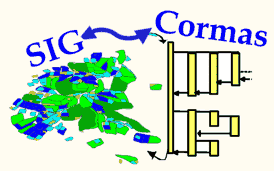
In some models, Cormas is associated to other
applications. These applications can be geographic
information systems (MapInfo or ArcView), data bases
(Access) or other models (Vensim).
The link between Cormas and the other applications can
be of type DLL, ODBC or DDE.
But the distinction between the various models depends
especially on the dynamics of the coupling.
Basic Coupling
Some models use data provided by another application (a
GIS for example), in order to initialize a spatial
configuration or the characteristics of agents. In the
case of a spatial configuration provided by a GIS,
Cormas work with vectorial spatial entities.
The models are the following ones:
[Burkina]: soil
quality indicators in Burkina Faso (Serge Guillobez).
[Gammanym] : Diffusion and
Social Networks: a Multi-Agent System/Network Theory
coupled approach applied to the study of adoption of a
new drug by doctors in Australia (Nazmun
N. Ratna, Anne Dray, Pascal Perez and
David Newth).
[WsErosion]: soil erosion risk and agricultural
diversification in a Northern-Thailand watershed (Guy
Trébuil, Christian Baron).
Dynamic Coupling
At the contrary, some others models exchange data with
others applications during the whole simulation run.
[DataBase]: Cormas configuration for exchanges with
Access databases by ODBC (Stanislas Boissau).
[MagmaS] : exchange of
stock-farm effluents in Reunion island (Manuel Martin,
Eric Piquet,
Christophe Le Page
and François
Guerrin). Cormas and Vensim are coupled
by DLL.
[MiRoya]
: Integration
with an R-based model. An interactive simulator
designed to help understand the biophysical mechanisms
underlying coffee leaf rust epidemics (P. Bommel).
[SaintGeorges]: pasture and overgrowing brushwood in a
village of Lozère, France (Emanuel Lieurain). Cormas,
Access and ArcView are coupled by ODBC and DDE.
[Zambeze]: land-use dynamics in the Zambeze valley
(Quinton Zunga, Antoine Vagnini, Christophe Le Page).
Cormas and ArcView are coupled by DDE.
|

