|
Spatialized
Prisoners Dilemma
A cell stands here for a player in the famous game
theory "Prisoners Dilemma" context. The payoff for the
different configurations are such that from an
individualist point of view, its better to defect
(whatever the strategy of the opponent, the best
individual payoff corresponds to the "defect" strategy),
whereas from a collective point of view, its better to
cooperate (the sum of the two individual payoffs is
maximal for the configuration "cooperate" vs
"cooperate").
The payoffs matrix is the following:
|
Cooperation |
Defection |
| Cooperation |
100; 100 |
0; 185 |
| Defection |
185; 0 |
0; 0 |
|
|
 |
With a Moore neighbourgood (8), the boundaries are
"periodic" (toroidal spatial grid). At each time-step,
the strategy of the players being set, each player
perform 9 games: with its 8 neighbours and also with
itself. The total payoff is then compared to the total
payoffs of the 8 neighbours players If one of them is
higher than the personal one, then the corresponding
strategy will be adopted for the next time-step. In such
a context, at the global level, does one of the two
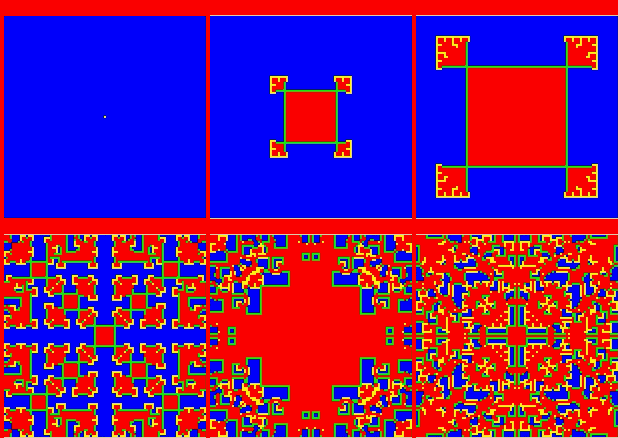
strategies invade the other ???... The movie displayed
here shows the intrusion of one defector in a world of
cooperators... The grid size is 101x101 and the defector
is initially located in the middle of the grid. The
stable defectors appear in red, or yellow for previous
cooperators just turning into defectors. The stable
cooperators appear in blue, or in green for previous
defectors just turning into cooperators.
- For more details about this cellular automata, look
at the following paper: Nowak, M.A. and May, R.M.
1992. Evolutionary games and spatial chaos. Nature,
359: 826-829.
|
|
