|
MARKETS : Markets
as communication systems
Assessing the performance of different market
institutions using computer simulations
Franck Galtier, Cirad.
The famous work by F. Hayek, L. Hurwicz, J. Stiglitz,
and S. Grossman showed that market performance depends
on an ability to ensure the dissemination of information
between economic stakeholders. As information is passed
on by the processes of negotiation and trade, the type
of trading network plays a crucial role since it
determines the architecture of the channels through
which information flows. Recent work has analysed this
aspect using mathematical tools (Kirman 1983; Ioannides
2002) or computer tools (Kirman and Vriend 2000; Kerber
and Saam 2001). The work described here falls into the
second category.
It involved a comparative analysis of the performance
of two modes of wholesale trade organization widely used
in agricultural commodity chains of the developing
countries: network trading and marketplace trading.
Store of a wholesaler in Niono (Mali) 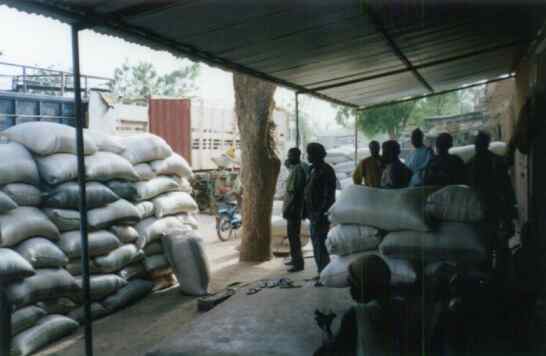
These two institutions function very differently. In
the case of a trading network, each wholesaler in a
consumer zone (CW) has correspondents (PW) in the
different production zones (one per zone) and, in
principle, should only procure supplies from his
correspondents. Thus, when a CW wishes to buy maize or
millet, he contacts his correspondents in different
locations (usually by telephone, or by mail delivered by
truckers or taxi drivers), centralizes the sale
proposals made by each of them (in terms of price,
quality, delivery date, terms of payment, etc.) and
enters into transactions with the one making the most
interesting bid. The entire process of negotiation and
exchange takes place at a distance. In the case of
wholesale markets, CWs circulate in the production
zones, where they meet PWs in the marketplaces (on
market day). The dissemination of information is
therefore very different in the two types of
institution.
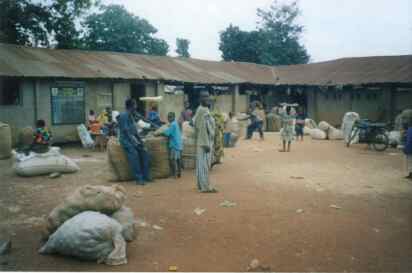 Wholesale markets in Kétou (Bénin) Wholesale markets in Kétou (Bénin)
Discussion on the relative performances of these two
institutions has major repercussions for public
policies. Indeed, States and funding agencies tend to
favour wholesale markets, which are judged to be
preferable for ensuring market "transparency". It is
this idea that we have attempted to test here, by
analysing whether any situations exist where trading
networks prove to be better communication systems than
wholesale markets.
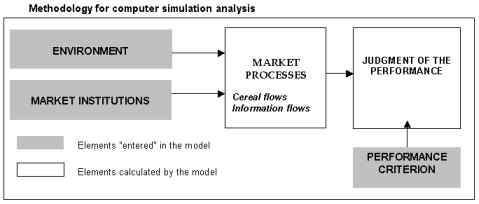 The analysis was based on
computer simulations using a multi-agent system (MAS).
The approach consisted in "entering" an (environment,
market institution) pair in the model, simulating the
induced exchange processes and measuring the efficacy of
the resource allocation obtained in that way (in
accordance with a previously defined performance
criterion). This approach (shown in the following graph)
makes it possible to test the comparative efficacy of
wholesale trading networks and wholesale markets in
different environments (to see their respective scope of
relevance). The analysis was based on
computer simulations using a multi-agent system (MAS).
The approach consisted in "entering" an (environment,
market institution) pair in the model, simulating the
induced exchange processes and measuring the efficacy of
the resource allocation obtained in that way (in
accordance with a previously defined performance
criterion). This approach (shown in the following graph)
makes it possible to test the comparative efficacy of
wholesale trading networks and wholesale markets in
different environments (to see their respective scope of
relevance).
In the scenarios performed, the environment was
modelled from two sets of variables: the degree to which
the activity was concentrated on the level of production
zone wholesalers (PWs) and the variability in supplies
to those wholesalers. The market institutions
represented were trading networks and wholesale markets,
along with an imaginary "perfect" institution, i.e. one
which enabled total market transparency and optimum
allocation of resources. This last institution was used
as a control to measure the efficiency of the other two.
Lastly, the performance criterion adopted was
the minimization of rationing in consumption localities.
The simulations involved 150 different scenarios (50
environments and 3 market institutions). Each of the 150
scenarios was simulated over 100 time periods,
approximately corresponding to two farming seasons,
taking a model time period to be a week in reality
(numerous marketplaces operate on a weekly basis). A
thousand simulations were carried out for each scenario,
in order to neutralize the effect of the random
variables introduced into the model.
The main results were as follows :
- Whilst networks and wholesale markets disseminate
far fewer bits of information than the control
institution, they manage to generate an allocation of
resources that is almost as good (at least when the
environment is unstable, which tallies with numerous
true situations). This is confirmation of the
intuition of F. Hayek and L. Hurwicz whereby market
institutions that are relatively economical in terms
of disseminating information can lead to an efficient
allocation of resources.
- The most decisive (environment) variable for the
comparative performance of the two institutions was
the number of production zone wholesalers (PWs). In
fact, when there are 15 PWs, networks always prove to
be more efficient than wholesale markets, whereas the
opposite is the case with 30 PWs. This result fits in
with the empirical reality of the cereal markets in
Mali and Benin. Indeed, in Mali, the activity is
highly concentrated at PW level: there are only around
ten per stockpiling locality. Conversely, in Benin,
this activity is covered by smaller scale PWs in
larger numbers (between 60 and 150 depending on the
stockpiling localities). Yet it is actually in Mali
(where the PWs are larger scale and fewer in number)
that trading networks are found and in Benin (where PW
activity is far more scattered) that wholesale markets
are found.
This result is contrary to the preconception whereby
wholesale markets are better communication systems than
trading networks. This should logically lead to a total
rethink of public policies in this field (which are
currently geared towards promoting wholesale markets).
Computer modelling of market processes proved to be
relevant in explaining how an efficient allocation of
resources can result from the decentralized interactions
of numerous individuals among whom the information is
dispersed. This approach thus complements other tools
such as the games theory or market experimentation
[Smith 1982; Roth 2001]. Its strong points are that it
enables an analysis of market processes within which
transactions take place "out of balance" (which is
difficult with the games theory), and involves numerous
stakeholders and quite long time periods (which
experiments do not allow).
This work also opens up a certain number of research
prospects. One of them consists in including elements
related to the "language" of the market institutions.
Indeed, The messages (embodied in the purchase and sale
proposals of the players) are expressed according to
rules that define how the different trading parameters
should be qualified (price, quantity, quality, payment
and delivery deadlines, and delivery site) and how they
should be negotiated. These rules (which constitute the
"market language") can also be assessed using computer
simulations.
Bibliography
AMSELLE, J.-L. (1977). Les commerçants de la savane :
histoire et organisation sociale des Kooroko (Mali).
Paris, Anthropos.
DEMBELE, N. et J. STAATZ (1989). Transparence des
marchés céréaliers et rôle de létat: La mise en place
dun système dinformation des marchés au Mali. Séminaire
European Seminar of Agricultural Economists.
EGG, J., F. GALTIER, et E. GREGOIRE (1996). "Systèmes
dinformation formels et informels - La régulation des
marchés céréaliers au Sahel." Cahiers des Sciences
Humaines 32(4): 845-868.
GALTIER, F. (2002). "Eclatement et incomplétude de la
théorie des marchés" Economies et Sociétés (in press).
GROSSMAN, S. (1989). The Informational Role of Prices.
Cambridge, MIT Press
HAMADOU, S. (1997). Libéralisation du commerce des
produits vivriers au Niger et mode dorganisation des
commerçants privés. Les réseaux marchands dans le
fonctionnement du système de commercialisation des
céréales. Economics PhD thesis, Montpellier, ENSA.M.
HAYEK, F. (1945). "The Use of Knowledge in Society",
American Economic Review 35(4): 519-530.
HURWICZ, L. (1969). "Centralization and Decentralization
in economic systems - On the Concept and Possibility of
Informational Decentralization", American Economic
Review 59: 513-524.
IOANNIDES, Y. (2002). "Topologies of Social
Interactions", Departement of economics, Tufts
University.
KERBER, W. and N. SAAM (2001)."Competition as a Test of
Hypotheses: Simulation of Knowledge-generating Market
Processes", Journal of Artificial Societies and Social
Simulation 4(3).
KIRMAN, A. (1983). "Communication in Markets: A
Suggested Approach", Economic Letters 12: 1-5.
KIRMAN, A. and N. J. VRIEND (2000). "Evolving Market
Structure: An ACE Model of Price Dispersion and
Loyalty", Journal of Economic Dynamics and Control (ACE
Special Issue).
LAMBERT, A. et J. EGG (1994). "Commerce, réseaux et
marchés : lapprovisionnement en riz dans les pays de
lespace sénégambien." Cahiers des Sciences Humaines 30:
229-254.
LE PAGE, C., F. BOUSQUET, et al. (2000). CORMAS: A
multiagent simulation toolkit to model natural and
social dynamics at multiple scales. Workshop "The
ecology of scales", Wageningen (Netherlands).
ROTH, A. (2001). "The Economist as Engineer: Game
Theory, Experimentation, and Computation as Tools for
Design Economics" Econometrica 70(4): 1341-1378.
SMITH, V. (1982). "Markets as economizers of
information: experimental examination of the "Hayek
hypothesis", Economic Inquiry 20: 165-179.
For further information, contact the author
or download the model (Cormas2003): markets
References
...soon !
|
|

