|
Use of Models as
Role-Playing Games
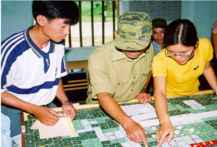
Some models developed with Cormas or MAS are used as
role-playing games. The conversion of the model into the
game is made possible by a certain analogy: the agents
of the model correspond to the actors of the game, the
rules of the model are similar to the roles of the game
and the simulation run correspond to the game session.
Works on this subject have in common to propose a
passage in both directions between the model and the
game. Model and game are complementary and grow richer
mutually. When the actors involved in the management of
a space or a resource play, they bring modifications to
the model.
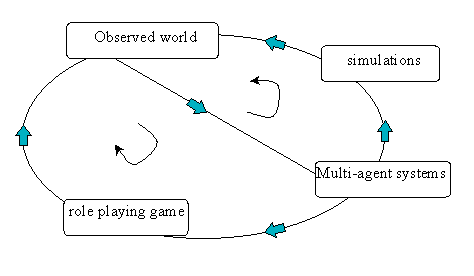
The approach for building models include generally a
diagnosis, a formalization and a validation. Then, the
models are used as multi-agent system or as role-playing
game, for training or for negotiating. After a first
use, the models are modified according to the behavior
of the real actors during the game.
Use of role-playing-game: the
approach
Models involved in role-playing games are the
following:
[AtollGame] : A role
playing game to provide information about the complexity
of interactions at stake dealing with groundwater
management in a small but nonetheless overcrowded atoll
in Micronesia (A.
Dray, P. Perez, P. dAquino).
[ButorStar] : A role
playing game for collective awareness of reedbed wise
use (R.
Mathevet , C. Le Page, M. Etienne, G. Lefebvre,
S. Proréol, B. Poulin, G. Gigot, A. Mauchamp).
[Cienaga] : Water quantity and
quality of the Ciénaga dam, Jujuy, Argentina (Grégoire
Leclerc and Pierre Bommel).
[ContaMiCuenca]
: Game for water management in Guanacaste, Costa Rica (Spanish
version. Grégoire
Leclerc and Pierre Bommel).
[Dukunu Mole] : A hybrid
simulator for participatory landscape planning in São
Tomé (Anne
Dray, Christophe
Le Page and Pierre Bommel).
[MaeSalaep] : A role
playing game about the interactions between crops
diversification and risk of erosion in a small watershed
of nothern Thailand (G. Trébuil,
B. Shinawatra-Ekasingh, F. Bousquet, C. Thong-Ngam).
[MejanJeu] : A role-game about pine
encroachment of natural ecosystems in Lozere, South of
France (M.
Etienne, C. Le Page).
[MineSet] :
Interactive simulation for sustainable forest management
in the Congo Basin (Anton Bommel,
Claude Garcia
and Anne Dray).
[Njoobari] : Organization
and coordination within irrigation systems in Senegal (O.
Barreteau, F. Bousquet et W. Daré).
[Pat] : A role playing game to
let local people from Bac Kan province (northern
Vietnam) discuss about access rules to a renewable
resource being more and more intensively used (S. Boissau, F.
Sempé).
[ReHab] : Re(sources)Hab(itat),
computer-assisted role-playing game (Christophe Le Page).
[Samba] : Land use in North VietNam (S. Boissau, J.-C.
Castella).
[MiRoya] : An interactive
simulator to understand the biophysical mechanisms
underlying coffee leaf rust epidemics (P.
Bommel).
[SelfCormas] :
Decentralized organization of land-use in Senegal (P. dAquino, A.
Bah, F. Bousquet, C. Le Page).
[Stratagenes] : In situ
management of phytogenetic resources in Madagascar (S. Aubert,
C. Le Page).
[SugarRice] : A
role-playing game to understand the expansion of
sugarcane in rainfed lowland paddies of upper northeast
Thailand (N. Suphanchaimart, F. Bousquet, I.
Patamadit, C. Wongsamun, G. Trébuil).
[Sylvopast] : A role-game,
built with Excel (© Microsoft), about sylvopastoral
management and wildfire prevention in Mediterranean
forests (M.
Etienne)
[VarzeaViva]
: Livelihoods of local communities in an Amazonian
floodplain coping with Global Changes (Marie-Paule
Bonnet et Pierre Bommel).
|

